
ERC: What is it? Where did it come from? Why do we do it?
ERC is a place for homeschool moms, made up of members and friends of University Reformed Church, to come together to give our children opportunities for fellowship and group learning about the Reformed Christian Worldview as distinct from surrounding cultures and opposing ideas.
It began over ten years ago as a group of moms 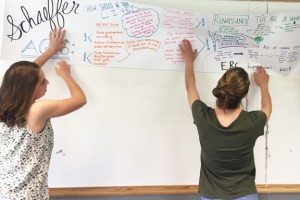 and kids meeting in their homes with a desire to teach their kids the Reformed worldview. As more URC friends grew interested, the moms decided to open it up to a church-wide co-op focusing on learning worldview through literature and art. Since starting in 2013, it has been exciting to see how the Lord has blessed and grown us into a little cottage school.
ERC is unique because it is a morning set apart for what is most important, a time to focus MUCH on God’s word and man’s view of the world in fellowship with other families. As parents, we all have firm opinions about our kids’ education and we are all coming from varied philosophies and backgrounds. Some of our parents practice a classical methodology, some resonate with Charlotte Mason’s ideas. We have families at excuse their kids from public school on Wednesday mornings to be here. We all come expecting to do things with the cottage school that we are unable to do in our individual homes. We want to be a place where we put our varied methodologies behind our central call as Christians to parent our children in the Lord; for this reason we focus much on just a few things.
At ERC we use the study of literature and art to teach the consequences of ideas, aiming always for our children to grow in love, understanding, and the ability to defend the biblical worldview. Through yearbook, we keep an annual chronicle of our Cottage School’s happenings to remind us of God’s faithfulness to our little culture centered on Christ, hoping our children will go out to shape the greater culture as ambassadors of his Kingdom. Ultimately, by training our kids together in this biblical way of seeing the world, we pray the Holy Spirit will move us to greater doxology and enjoying our great God.
Much Not Many: What does our motto mean?
It was once said that it is the habit of a wise man to know something deeply, not to know many things. Here at ERC, we want to ascend to this simple, yet difficult, and truly profound ideal– Much, Not Many.
So what in the world is this motto that is on our t-shirts and our website, and why should we focus our efforts according to this ethic? Much of what we mean by this ethic can be summed up in Andrew Campbell’s article at Memoria Press entitled, Much, Not Many.
The idea comes from the latin phrase “Multum, non multa” and is often translated, “Not many, but much.” It was first articulated by Pliny the Younger, a great law-maker and thinker in Ancient Rome. Since his assertion, many educators following, especially those with an eye toward classical thought, seek to govern their educating by the principle.
The ideal of the modern and now postmodern American school-system over last 100 or so years can be summarized by an attempt to prepare youth to enter society by giving them a survey-experience in their academic process, one that would strive to expose them to a vast expanse of subject matter and content, moving at a rapid pace, and briefly familiarizing students with a cursory level of subject understanding. This philosophy allows for strategic promotion of particular sociological ideology as opposed to teaching the student to know and reason as an individual.
The ideal Much, Not Many seeks to do the opposite, that is, teach the student a very limited amount of subject matter in great depth at a slow, deliberate pace always with an eye on cultivating individual thinkers. It is a motto that is realistic about our ability and capacity as creatures and one in keeping with the biblical ethic of being good stewards of the best things in God’s world. When our education leaves us vaguely familiar with a wide array of different things, we have a tendency to undervalue the best things and fail to see their Maker’s providential hand behind them.
So how do we do this? At ERC we want to drink deeply and slowly from the best springs. This is why we choose to focus our time together on Christ-exalting worship and catechizing during chapel. Classroom time is focused on preparing for and discussing excellent works of literature while practicing biblical skills of discernment and worldview identification. We believe that we enhance these values by enjoying beauty through art and logic classes and chronicling our experience as a covenant community by producing a yearbook.
The Much, Not Many ideal does not only regulate the subject matter we choose to focus on though. It also informs the content we select and the pace we employ as we learn together. We want to slow down, deliberately choosing to do the best things well. The skills we teach, the books we select, the classroom discussions we promote and the homework we assign must all be carefully selected to promote a few ideas and their consequences. We want to always be asking ourselves as teachers, “Why am I selecting this book? Why am I teaching this skill? What do I want my student to know or value at the end of this lesson, at the end of this semester, at the end of this school-year, and does this activity truly fit?” We want to always be asking our students to ponder the most significant questions like “Who is God? What is man like? How should we live?”
To this end we work hard to break down each grade or learning level into a set of clear skills and values we wish to promote and worldview-like questions we want to answer, in order that teachers, parents, and kids know what we are shooting for as we progress through each year and, most importantly, to what end.
At ERC we love to exalt Christ Jesus. That is our end and our chief joy. In order to prepare our children to exalt him and promote his Kingdom for a life-time, we want to teach them to reason and to discern what is truly beautiful in this world he made. We want to enjoy God’s Word together, and we want to deepen and practice our skills of worldview identification and discernment so that we raise up a generation of faithful, reasoning Christians who promote, love, and live-out the ideas that Christ loves.
In order to accomplish this lofty task, we need the Lord’s grace and help, we need to be disciplined, and we need to know our limits well. We want to fight hard to resist the knee-jerk ideal that says more is better: “more subjects, more content, more books, more assignments!” Instead, we want to ascend together to this simple, profound, incredibly difficult discipline– to slow down and drink deeply from a few subjects, a few excellent (often classic) books, a few key concepts in order to help our kids reason biblically. Much, not many is the discipline by which we seek to instruct our kids at ERC, the habit is not easy, but the things worth doing never are.
Why is Chapel important, and what do we do there?
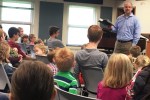 True fellowship always flows from true worship. We have fellowship together because we want to exalt Jesus Christ with our learning and our lives. Therefore it is fitting that we would begin our meetings with worship. ERC begins each session with a brief Chapel time where we sing, pray, and learn from a dad or pastor about the Lord- what he has done and what he requires. It is a sweet time of unity and of recalling why we do what we do. We remind each other that Jesus is Lord and we want to live, learn, and love one another for his honor.
To view past chapel talks, click on the Chapel tab above.
 ERC
ERC 
You must be logged in to post a comment.